
Published January 14, 2026
How to Buy Your First Investment Property: Step‑by‑Step Guide

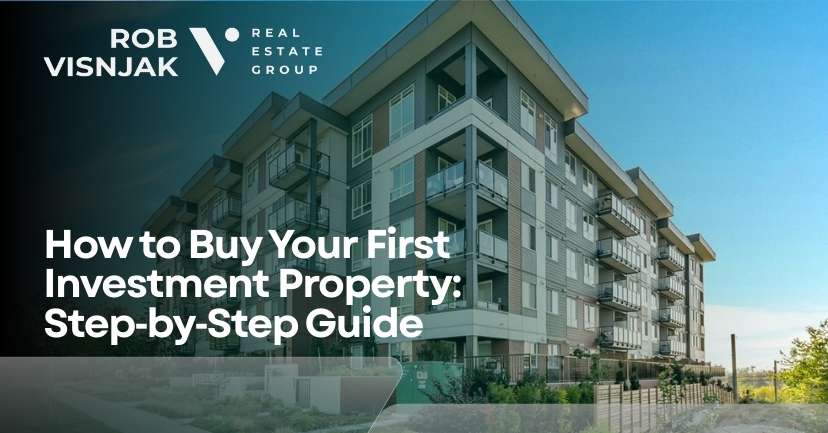
Buying your first investment property is an exciting milestone that can set you on the path to financial freedom and long-term wealth building. Understanding how to buy your first investment property properly is essential to making smart decisions, avoiding costly mistakes, and establishing a foundation for future investment success. While approximately 6% of home purchases are for investment purposes, first-time investors who approach the process strategically and systematically significantly increase their chances of profitable outcomes.
At the Rob Visnjak Real Estate Group, we work with first-time investors throughout the Fraser Valley who are ready to take the leap into real estate investing. Purchasing an investment property differs fundamentally from buying a primary residence—it requires analytical thinking, rigorous financial analysis, and a focus on return on investment rather than personal preferences. The decisions you make with your first investment property will shape your investing habits and success for years to come.
This comprehensive step-by-step guide will walk you through the entire process of buying your first investment property from start to finish. From setting clear goals and securing financing to finding the right property, analyzing the numbers, and closing the deal, we cover every critical step you need to take. Whether you're considering rental properties in Langley, Surrey, or other Fraser Valley markets, this guide provides the roadmap you need to make your first investment with confidence.
Key Takeaways
-
Define Clear Goals: Determine whether you're seeking cash flow, appreciation, or both before buying.
-
Secure Financing Early: Get pre-approved to understand your buying power and act quickly on opportunities.
-
Analyze Every Number: Base every decision on cash flow projections, ROI calculations, and market data.
-
Start with Single-Family: Begin with manageable properties before scaling to multifamily units.
-
Build Your Team: Surround yourself with experienced professionals who specialize in investment properties.
Step 1: Set Clear Investment Goals
Before you start searching for your first investment property, get absolutely clear on what you want to achieve. Are you looking for monthly cash flow to supplement your income, long-term wealth through property appreciation, tax benefits and deductions, portfolio diversification beyond stocks and bonds, or eventual financial independence through passive income? Your goals will determine the type of property you buy, where you invest, and how you finance it.
Different investment objectives require different strategies. If you need immediate cash flow, focus on properties in areas with strong rental demand where rent significantly exceeds your monthly expenses. If you're building long-term wealth for retirement, you might prioritize properties in growth areas where appreciation potential outweighs immediate cash flow. Understanding your primary objective prevents you from making emotional decisions or choosing investments that don't align with your financial goals.
Consider your investment timeline as well. Are you planning to hold the property for 5 years, 10 years, or indefinitely? Your timeline affects everything from the properties you target to the financing structure you choose. Long-term investors typically benefit from fixed-rate mortgages and properties with stable, appreciating values, while shorter-term investors might use different strategies. Having clarity upfront keeps you focused and prevents costly mistakes.
Step 2: Assess Your Financial Readiness
Determining your financial readiness is crucial before buying your first investment property. Start by honestly evaluating your current financial position including credit score (lenders typically require 680+ for investment properties), existing debt and debt-to-income ratio (DTI), available capital for down payment and reserves, stable income to support financing, and emergency fund covering 6+ months of personal expenses.
Check your credit score and review your credit report for any errors or issues that could affect your ability to qualify for investment property financing. If your credit score is below 680, work on improving it before applying for a loan by paying down high-interest debt, making all payments on time, and reducing your credit utilization ratio. A higher credit score not only improves your approval odds but also qualifies you for better interest rates.
Calculate your debt-to-income ratio by adding up all monthly debt payments and dividing by your gross monthly income. Many lenders want this below 36-45% for investment property loans. If your DTI is too high, focus on paying down existing debt before taking on an investment property mortgage. Remember that lenders can count 75% of projected rental income toward your qualifying income, which can help offset the new mortgage payment.
Step 3: Save for Your Down Payment and Reserves
Investment properties require larger down payments than primary residences—typically 20-25% of the purchase price. On a $400,000 property, that means you'll need $80,000-$100,000 for the down payment alone. Beyond the down payment, you'll also need funds for closing costs (2-5% of purchase price), property inspection and appraisal fees, immediate repairs or improvements, and cash reserves for emergencies and vacancies.
Many lenders require you to have 6-12 months of mortgage payments in reserve after closing. This reserve requirement protects both you and the lender if the property sits vacant or needs unexpected repairs. Build your down payment and reserves systematically by setting aside a fixed percentage of your income each month, cutting unnecessary expenses, considering a side hustle to accelerate savings, and potentially using a home equity line of credit (HELOC) against your primary residence.
Don't rush to buy before you have adequate reserves. Many first-time investors underestimate the importance of cash reserves and find themselves in financial trouble when their first tenant moves out or a major repair is needed. Having sufficient reserves is just as important as having the down payment.
Step 4: Get Pre-Approved for Financing
Before you start actively searching for properties, get pre-approved for an investment property loan. Pre-approval tells you exactly how much you can borrow, demonstrates to sellers that you're a serious buyer, allows you to move quickly when you find the right property, and helps you understand your monthly payment obligations. Investment property loans come with stricter requirements than primary residence mortgages including higher down payments (20-25%), higher interest rates (typically 0.5-0.75% above primary residence rates), stronger credit requirements, and lower loan-to-value ratios.
Shop around with multiple lenders to compare rates and terms. Different lenders have different criteria and offerings for investment properties, so it pays to get quotes from traditional banks, credit unions, online lenders, and portfolio lenders. Ask each lender about their requirements for projected rental income, how they verify your reserves, what documentation they'll need, and whether they have experience with investment property loans.
Understand that pre-approval is different from pre-qualification. Pre-qualification is a soft estimate based on self-reported information, while pre-approval involves a thorough review of your financial documents, credit check, and verification of income and assets. Only pre-approval carries significant weight with sellers.
Step 5: Research and Select Your Target Market
One of the most critical decisions you'll make is where to invest. Location drives investment property success more than any other factor. Research potential markets by analyzing strong job growth and employment diversity, population growth and demographic trends, median income levels and affordability, rental demand and vacancy rates, property appreciation history, and local regulations and landlord-friendly laws.

For your first investment, consider starting in your local area where you understand the market, can easily inspect properties, know the neighborhoods and school districts, and can manage the property yourself if needed. Our home value calculator can help you understand property values in different Fraser Valley neighborhoods. As you gain experience, you can expand to other markets.
Research the local rental market thoroughly before investing. Look up average rent prices for your target property type on sites like Rentometer, Zillow, or local rental listings. If you can collect monthly rent equal to or greater than the median for the area, it's likely a good investment opportunity. Also check vacancy rates—high vacancy indicates weak rental demand and should be avoided. Talk to local property managers about rental demand, typical tenant profiles, and seasonal rental patterns.
Step 6: Define Your Buy Box Criteria
Create a specific "buy box" that defines exactly what type of property you're looking for. This focused approach prevents you from wasting time on unsuitable properties and helps you recognize good opportunities quickly. Your buy box should include property type (single-family home, duplex, condo, townhouse), geographic area and specific neighborhoods, price range based on your financing, number of bedrooms and bathrooms, property age and condition, and minimum investment return requirements.
For your first investment property, most experts recommend starting with single-family homes in stable, established neighborhoods. Single-family rentals are easier to finance than multifamily properties, attract long-term tenants and families, are simpler to manage for beginners, and are easier to sell if needed. As you gain experience and build equity, you can expand into multifamily units, commercial properties, or other investment types.
Set specific minimum return requirements such as minimum monthly cash flow (e.g., $200-300 per month), target cash-on-cash return (e.g., 8%+), acceptable cap rate for the market, and maximum acceptable vacancy factor. Having clear numerical criteria helps you evaluate properties objectively rather than emotionally.
Step 7: Find and Analyze Potential Properties
Start searching for properties that meet your buy box criteria using online listings (MLS, Zillow, Realtor.ca), working with a real estate agent who specializes in investment properties, networking with other investors for off-market deals, driving neighborhoods to find for-sale-by-owner properties, and attending local real estate investment meetups. Understanding the home buying process will help you navigate each step effectively.
For each potential property, conduct rigorous financial analysis. Calculate all ownership costs including mortgage payment (principal, interest, taxes, insurance), property management fees (typically 8-10% of rent), maintenance and repairs (budget 1% of property value annually), vacancy allowance (typically 5-8% of annual rent), capital expenditure reserves for major repairs, and HOA fees if applicable. Then calculate your expected rental income based on comparable rentals in the area.
Use these key metrics to evaluate each property: Net Operating Income (NOI) = Gross Rental Income - Operating Expenses, Cap Rate = NOI / Purchase Price, Cash-on-Cash Return = Annual Cash Flow / Total Cash Invested, and Gross Rent Multiplier = Purchase Price / Annual Gross Rent. A fundamental rule: make sure the rent covers your mortgage plus at least $200-300 minimum for a reasonable margin of safety.
Step 8: Make an Offer and Conduct Due Diligence
When you find a property that meets your buy box criteria and the numbers work, it's time to make an offer. Work with your real estate agent to prepare a competitive offer based on comparable sales in the area, include appropriate contingencies to protect yourself, and present your pre-approval to demonstrate seriousness. Key contingencies should include inspection contingency (7-10 days to inspect), financing contingency (to secure final loan approval), appraisal contingency (property must appraise at purchase price), and potentially a rent verification contingency.
Once your offer is accepted, immediately schedule a comprehensive property inspection. Hire a qualified inspector to evaluate structural integrity, roof condition, foundation, electrical and plumbing systems, HVAC condition, potential water damage or mold, and pest issues. The inspection protects you from buying a property with hidden defects that could cost thousands to repair.
Review the inspection report carefully with your agent. For any significant issues discovered, you have several options: request that the seller make repairs before closing, negotiate a price reduction to account for needed repairs, ask for a credit at closing to cover repair costs, or walk away from the deal if problems are too severe. Don't skip the inspection to save money—it's one of the most important protections you have.
Step 9: Finalize Financing and Close the Deal
Once you're through the inspection period and have negotiated any necessary repairs or credits, work with your lender to finalize your financing. Provide all requested documentation promptly including pay stubs and tax returns, bank statements showing reserves, current lease agreements if the property has existing tenants, and property insurance quotes. Your lender will order an appraisal to confirm the property value supports the loan amount.
If the appraisal comes in below the purchase price, you have several options: renegotiate the purchase price with the seller, bring additional cash to closing to make up the difference, or walk away using your appraisal contingency. Low appraisals are less common with investment properties than primary residences, but they do happen, especially if you overpaid relative to market value.
Review all closing documents carefully, including the settlement statement showing all costs, the deed transferring ownership, the mortgage note and deed of trust, property insurance documents, and any existing tenant leases. Conduct a final walk-through before closing to ensure the property is in the agreed-upon condition and any negotiated repairs have been completed. At closing, you'll sign documents, transfer funds, and receive the keys to your first investment property.
Step 10: Prepare the Property and Find Tenants
After closing, prepare your property for tenants if it's not already rented. Complete any necessary repairs or improvements, ensure all systems are functioning properly, clean thoroughly (or hire professional cleaners), and make cosmetic improvements that maximize rental appeal. Don't over-improve—focus on clean, functional, and safe rather than luxury upgrades that don't increase rent.
Market your rental property effectively by taking professional-quality photos, listing on multiple rental platforms (Zillow, Craigslist, Facebook Marketplace, Rentals.ca), working with local property managers who have tenant databases, and putting up yard signs in the neighborhood. Set the right rent based on your market research—competitive pricing fills vacancies faster.
Screen tenants thoroughly to avoid future problems. Check credit reports and scores, verify employment and income (rent should be 25-30% of gross income), contact previous landlords for references, run criminal background checks where legally permitted, and meet applicants in person to assess responsibility. Good tenant screening is one of the most important skills for successful rental property investing. Create a clear, comprehensive lease agreement that protects your interests and complies with local landlord-tenant laws.
Frequently Asked Questions (FAQ)
1. How much money do I need to buy my first investment property?
Expect to need at least 20-25% down payment plus closing costs and 6-12 months of reserves, totaling roughly 30-40% of the purchase price.
2. What credit score do I need for an investment property loan?
Most lenders require a minimum credit score of 680, though 700+ significantly improves your rates and approval chances.
3. Should I buy a single-family home or multifamily for my first investment?
Start with a single-family home in a stable neighborhood—they're easier to finance, manage, and sell than multifamily properties.
4. How do I know if an investment property will be profitable?
Calculate whether monthly rent covers your mortgage plus at least $200-300, and verify positive cash flow after all expenses including vacancies and repairs.
5. Do I need a property manager for my first rental?
Not necessarily, but property managers (8-10% of rent) save significant time and may be worthwhile if you work full-time or own out-of-area property.
6. Can I use rental income to qualify for my mortgage?
Yes, most lenders will count 75% of projected rental income toward your qualifying income on investment property loans.
7. What are the biggest mistakes first-time investors make?
Overestimating rental income, underestimating expenses, buying in weak markets, having inadequate reserves, and getting emotional about properties.
8. How long should I plan to hold my first investment property?
Plan to hold for at least 5-7 years to benefit from appreciation and tax advantages, though long-term buy-and-hold is the most common strategy.
Conclusion
Buying your first investment property is an exciting step toward building wealth through real estate, but success requires careful planning, thorough analysis, and disciplined execution. By following these steps—setting clear goals, assessing your finances, securing financing, researching markets, defining criteria, analyzing properties rigorously, conducting due diligence, and finding quality tenants—you position yourself for a successful first investment that can launch a profitable real estate portfolio. Remember to stay analytical rather than emotional, trust the numbers, and don't rush into a purchase that doesn't meet your criteria.
The Rob Visnjak Real Estate Group works with first-time investors throughout the Fraser Valley, helping them identify opportunities, analyze properties, and navigate the investment property purchase process. Our local market expertise and experience can help you avoid common mistakes and make informed decisions that align with your investment goals. If you're ready to buy your first investment property in Langley, Surrey, or surrounding communities, we invite you to connect with us today. Let us help you take that important first step toward financial freedom through real estate investing.
|


or another way