
Published September 26, 2026
The Surrey–Langley SkyTrain: Which Surrey Neighbourhoods Are Repricing First

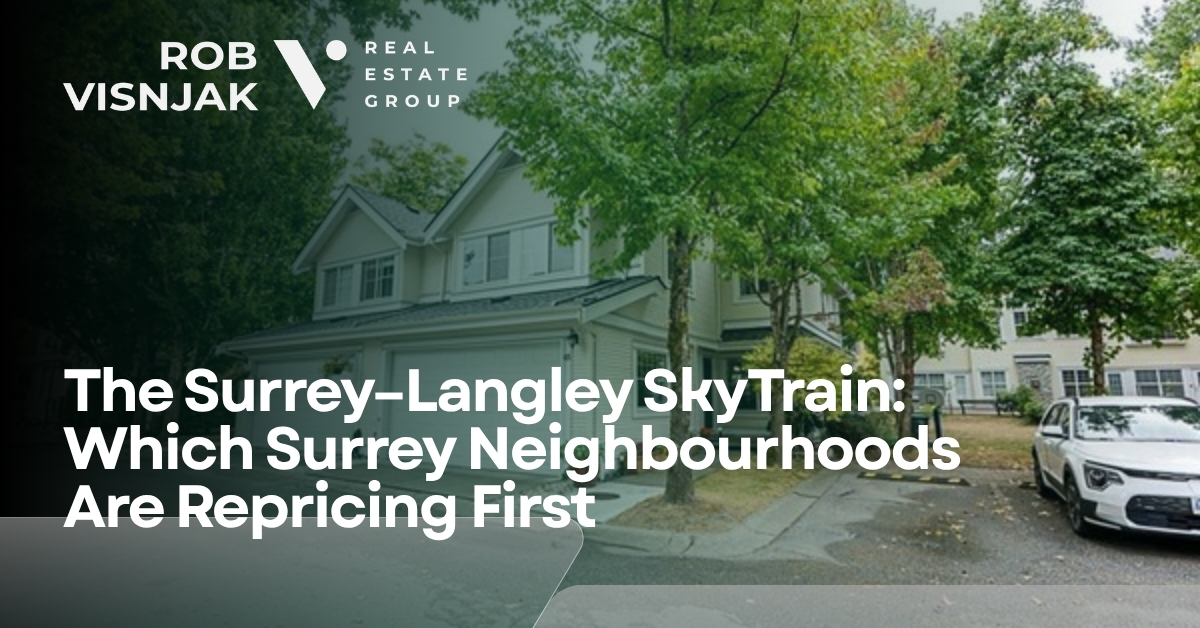
Fleetwood is repricing first. The neighbourhood holds three of the eight new Expo Line stations, the City of Surrey already approved a 30-year Fleetwood Plan around those stops, and station structures were visible above ground in 2026 while other corridor nodes were still mostly foundations.
The line itself is no longer a rumour. The Province now calls the 16-kilometre extension the Dave Barrett Extension. It runs from King George Station to Langley City Centre along Fraser Highway, adds eight stations, and is budgeted at $5.996 billion. Official project materials target service in late 2029, with opening-year weekday ridership of about 56,000 rising toward 80,000 by 2050. Travel time from Langley City Centre to King George is planned at 22 minutes.
That timetable is already showing up in how buyers sort Surrey streets. If you are mapping a first offer along the corridor, start with buying a home in Surrey and the first-time buyer path.
Why Some Blocks Reprice Before the First Train Arrives
Values move when certainty rises, not when the first chime sounds. Construction, station locations, and legal density are all public in 2026. That is the stage where past Metro Vancouver extensions started to split the walking catchment from the rest of the suburb.
A McGill University study of Montreal's REM found that the project announcement raised housing premiums within 800 metres of parts of the corridor, and that those premiums held through construction. Vancouver's Canada Line and Evergreen Extension produced the same pattern in a different form: buyer demand clustered inside a short walk of the future platform years before opening day.
B.C. then locked the walking band into law. Bill 47 requires municipalities to designate Transit-Oriented Areas within 800 metres of a SkyTrain station and to allow much higher density on residentially zoned land inside that circle. Surrey mapped those areas in 2024. The planning premium and the buyer premium now sit on the same map.
The three Transit-Oriented Area tiers
|
Distance from station |
TOA tier |
Minimum density |
Minimum height |
|
0 to 200 metres |
Tier 1 |
5.0 floor area ratio |
20 storeys |
|
200 to 400 metres |
Tier 2 |
4.0 floor area ratio |
12 storeys |
|
400 to 800 metres |
Tier 3 |
3.0 floor area ratio |
8 storeys |
Those figures come from the provincial Transit-Oriented Development Areas regulation and from Surrey's own zoning schedules. Floor area ratio is the building's total floor area divided by the lot size. A 5.0 FAR on a 10,000-square-foot lot is 50,000 square feet of building. That is a different land value than a single detached house on the same parcel.
The Surrey Station Map, West to East
Six of the eight new stations sit in Surrey. Willowbrook and Langley City Centre sit in Langley and belong in a Langley corridor article, not this one. On the Surrey side the line is not one neighbourhood. It is six different land markets sharing one guideway.
|
Station |
Neighbourhood |
2026 construction read |
Repricing rank |
|
Green Timbers |
140 Street / hospital edge |
Above-ground structure visible |
6. Constrained |
|
152 Street |
West Fleetwood |
Foundations later than Fleetwood |
3. Fast follower |
|
Fleetwood |
160 Street town centre |
Structure visible; plan core |
1. First |
|
Bakerview-166 Street |
East Fleetwood |
Guideway active; bus exchange |
2. First-adjacent |
|
Hillcrest-184 Street |
North Cloverdale edge |
Corridor node, thinner plan |
5. Second wave |
|
Clayton |
Clayton Heights / 190 Street |
Family townhome stock |
4. Second wave |
September 2026 provincial updates put guideway construction at about 65 percent complete, with foundation piles and columns more than 95 percent complete. The Fleetwood Flyer was finishing roughly three kilometres of guideway in October 2026. Visible steel changes how a touring buyer prices a street. A drawing on a website does not.
1. Fleetwood Town Centre Reprices First
Fleetwood Station at Fraser Highway and 160 Street is the first Surrey node that checks every box at once: a named town centre, three stations inside one plan area, a high street planned on 160 Street, and construction you can photograph from the sidewalk.
Stage 1 of the Fleetwood Plan covers more than 2,200 acres along the corridor. City materials and contemporary reporting on the 2022 Stage 1 approval described a 30-year shift from about 13,000 homes and 40,000 residents to about 28,000 homes and 84,000 residents. Growth is supposed to stack at the stations, then step down into existing streets.
That is why 160 Street moves first. The plan put the tallest mixed-use core here, including employment space around the 166 Street station and a civic cluster at the community centre, library, and Francis Park. Provincial TOA rules then layered a legal minimum of 4.0 FAR and 12 storeys onto residentially zoned lots 200 to 400 metres from the platform. City files have already tested applications above that floor, including a 30-storey mixed-use proposal near 84 Avenue and 160 Street inside the 200-to-400-metre band.
Surrey Mayor Brenda Locke put the geography in plain language when station work reached every site: the extension "will improve how people get around in City Centre, Fleetwood, and Cloverdale, and play an important role in shaping the future of these communities as they continue to grow."
What that means for a 2026 buyer
• A lot inside 200 metres is a land story first and a house story second.
• A townhome 400 to 800 metres from 160 Street still sits in the legal TOA and in the walking catchment.
• A detached home south of 84 Avenue can be a strong family house and still miss the first repricing wave.
Price context is the official board file, not a street-by-street promise. The Fraser Valley Real Estate Board August 2026 MLS Home Price Index put Surrey Central detached homes at $1,322,800, townhomes at $748,000, and apartments at $462,800. Fleetwood sits inside that Surrey Central area. Use those benchmarks as the starting grid, then read solds on the exact block. Search current Surrey listings only after you know which band you are shopping.
2. East Fleetwood and Bakerview-166 Street Move With It
Bakerview-166 Street is the east half of the same Fleetwood Plan, not a separate suburb. The station sits beside the Surrey Sport and Leisure Complex and is one of three new transit exchanges on the line. The Fleetwood Plan also flags an employment district around 166 Street.
That combination creates a different first-wave product mix than 160 Street. Civic traffic and the exchange pull rental demand. The employment designation pulls assembly interest on commercial and mixed-use parcels. Family townhomes a few blocks off Fraser Highway still get the 800-metre TOA label without sitting on the loudest corner.
If Fleetwood Station is where the skyline argument starts, Bakerview-166 Street is where daily use starts. Buyers who care about a gym, a pool, and a future bus-to-SkyTrain transfer will reprice this node in the same window as 160 Street, not years later.
3. West Fleetwood at 152 Street Is the Fast Follower
152 Street Station sits between Green Timbers and Fleetwood. It is inside the Fleetwood Plan, so it inherits the same long-term density logic. It does not inherit the same 2026 visibility or the same civic cluster.
Stage 1 planning language treated this node as a lower-height core than 160 Street. Contemporary coverage of the approved concept capped towers near 152 Street around 30 storeys, versus a taller allowance around the 160 Street station. That still dwarfs a duplex street. It is not the same land-assembly heat as the town-centre crossroads.
Foundation work at 152 Street also ran behind Fleetwood and Green Timbers in the May 2026 federal and provincial update. Buyers tour what they can see. A fast-follower station still reprices. It just does it after the camera-ready stop next door.
4. Clayton Heights Is the Second Wave, Not the First
Clayton Station at about 190 Street is the family-product play on the Surrey side. Clayton Heights is a post-2000 planned community of compact lots, townhomes, and coach-house streets. It already behaves like a transit neighbourhood on the ground. The train is the missing piece.
The Cloverdale HPI area, which captures Clayton-side family stock, posted an August 2026 detached benchmark of $1,339,700 and a townhome benchmark of $757,200. Those tickets are close to Surrey Central. The housing mix is not. Clayton buyers are usually shopping a 10-to-20-year-old townhome or a small detached house, not an assembly lot under a future tower.
That is why Clayton is second, not first. End-user families will pay for a shorter ride to King George and Waterfront. Investors will pay for suite and coach-house rent against a future station walk. Neither group is waiting on a 20-storey rezoning the way the 160 Street core is. The premium arrives, just on a different product.
If the monthly payment is the binding constraint, read how the mortgage process and the home-buying steps treat a townhome with a suite differently from a bare lot in a Tier 1 circle.
5. Hillcrest-184 Street Is a Corridor Node
Hillcrest-184 Street sits where Fleetwood's plan energy thins out and Cloverdale's northern edge begins. It is a real station. It is not a second town centre.
The 184 Street node will matter for commuters who want a platform without paying the first-wave Fleetwood asking price. Mid-density applications and townhome resales inside 800 metres are the product to watch. Detached streets that only "feel close" on a driving map are not in the same trade.
Treat 184 Street as a second-wave location unless the specific lot is inside the 200-metre tier and already attracting assembly offers. The station creates option value. It does not automatically rewrite every tax folio on the grid.
6. Green Timbers Reprices the Least Like a Typical Suburb
Green Timbers Station at 140 Street and Fraser Highway is early in the construction photo record and late in the land-assembly story. The site sits against Green Timbers Urban Forest, the Jim Pattison Outpatient Care and Surgery Centre, RCMP E Division Headquarters, and the hospital precinct.
Those neighbours cap how much of the 800-metre circle can become housing. A large share of the walking catchment is forest, institutional land, or already-built medical and office space. The station still helps hospital staff, outpatients, and renters who want an Expo Line ride without going into City Centre. It does not create the same volume of redevelopable lots as Fleetwood Town Centre.
Buyers who treat Green Timbers like 160 Street will overpay for a story the land cannot support. Buyers who treat it as a jobs-and-forest station will price it correctly.
Which Home Types Capture the First Move
The SkyTrain premium is not a blanket added to every Surrey listing within a kilometre of Fraser Highway. It attaches to specific rights on specific lots.
|
Home type |
Where it captures value first |
Main risk |
|
Older detached on a wide lot |
0 to 200 metres in Fleetwood |
You are buying land. The house may be a holdover. |
|
Townhome inside 800 metres |
Fleetwood, 166 Street, Clayton |
New supply and construction noise until 2029. |
|
Existing low-rise condo |
Near 160 Street and 152 Street |
Special levies, parking rules, and new-tower competition. |
|
Pre-sale or new apartment |
TOA cores and plan designations |
Completion timing versus the late-2029 in-service date. |
|
Family detached outside the circle |
South of 84 Avenue, south Clayton |
Lifestyle value stays. Transit premium is thin. |
Board-wide prices still matter as the backdrop. Fraser Valley composite benchmarks in summer 2026 sat roughly 26 percent below the 2022 peak, and the August 2026 composite was about $869,900. A corridor premium on a softer regional tape is not the same as a 2021 bidding war. Get a current home value read if you already own inside one of these bands, and get a buyer consult before you treat a station pin as a guaranteed lift.
What Is Already Priced In, and What Is Not
Three years of blog posts have advertised a 10 to 20 percent "SkyTrain premium." Treat that range as a historical band from earlier extensions, not a coupon on your offer.
• Already visible to the market: the route, the eight station names, the late-2029 target, and the 800-metre TOA circles.
• Partly priced in: Fleetwood town-centre applications, construction photos at 160 Street and Green Timbers, and family demand in Clayton.
• Not fully priced in: actual in-service reliability, bus-exchange operations at 166 Street, and which assemblies actually get built before opening.
• Easy to overpay for: homes that only share a school catchment or a driving time with a station.
Opening-day commute math is the cleanest number that is not yet fully in resale prices. Official materials say the ride from Langley City Centre to King George will take 22 minutes, more than 25 minutes faster than the current bus. Fleetwood and Clayton capture a large share of that time saving without sitting at the Langley terminus. That is the first-time buyer case for shopping Surrey's six stations instead of waiting for the end of the line.
Langley still matters if your budget or school map points east. Compare that side on the Langley page after you decide whether you need a Surrey station walk or only a shorter regional ride.
A Practical Order of Operations for First-Time Buyers
Do not start with a listing photo of a station rendering. Start with the band, the housing type, and the payment.
1. Pick the station, then measure 200, 400, and 800 metres on a map. If the listing agent cannot tell you the tier, walk it.
2. Decide whether you are buying a home to live in, a lot with option value, or a rental. Those are three different offers.
3. Stress-test the payment against construction disruption through 2029. Guideway work is already in the street.
4. Get financing in place before you write on a TOA lot. Start with financing guidance and the buyer's process.
5. Tour Fleetwood and 166 Street first if you want the earliest repricing. Tour Clayton if you want a family townhome and can live with the second wave.
6. If you are stuck between two blocks, connect with Rob V. and walk both catchments on the same day.
FAQ
When does the Surrey-Langley SkyTrain open?
The Province and the official project office target late 2029 for the start of service. As of September 2026, guideway construction was about 65 percent complete and all eight stations were under construction.
Which Surrey neighbourhood will see home values rise first because of SkyTrain?
Fleetwood is first. It has three stations inside one town-centre plan (152 Street, Fleetwood at 160 Street, and Bakerview-166 Street), visible station structures in 2026, and provincial Transit-Oriented Area density already mapped within 800 metres of each stop.
How close to a station do you need to be for a SkyTrain premium?
The strongest planning and buyer effect sits inside 800 metres, which is also the legal Transit-Oriented Area radius around a SkyTrain station in B.C. Within 200 metres, the province requires municipalities to allow up to 5.0 floor area ratio and 20 storeys on residentially zoned land.
Will every home near a Surrey SkyTrain station go up in value?
No. Past Metro Vancouver extensions and recent rapid-transit studies show a premium is most consistent inside the walking catchment, and it is not uniform. A 1950s bungalow on an assembly-capable lot 150 metres from Fleetwood Station is a different asset than a new townhome 1.4 kilometres south of Fraser Highway.
Does the SkyTrain go through historic Cloverdale?
No. The guideway follows Fraser Highway. Hillcrest-184 Street and Clayton stations sit on the northern Clayton and Cloverdale edge. The historic Cloverdale town centre south of that corridor is not a station area.
Should first-time buyers wait until the line opens in 2029?
Waiting until opening means buying after construction certainty, after Transit-Oriented Area applications, and after three more years of buyer competition for walkable stock. Fraser Valley benchmarks in mid-2026 were already well below the 2022 peak. Shop the station band you can actually carry, then confirm financing before you tour.

Rob Visnjak Personal Real Estate Corp
Team Lead | ROB VISNJAK REAL ESTATE GROUP
or another way