
Published September 12, 2026
Short-Term Rentals in Surrey: Licensing Rules and Where They're Permitted

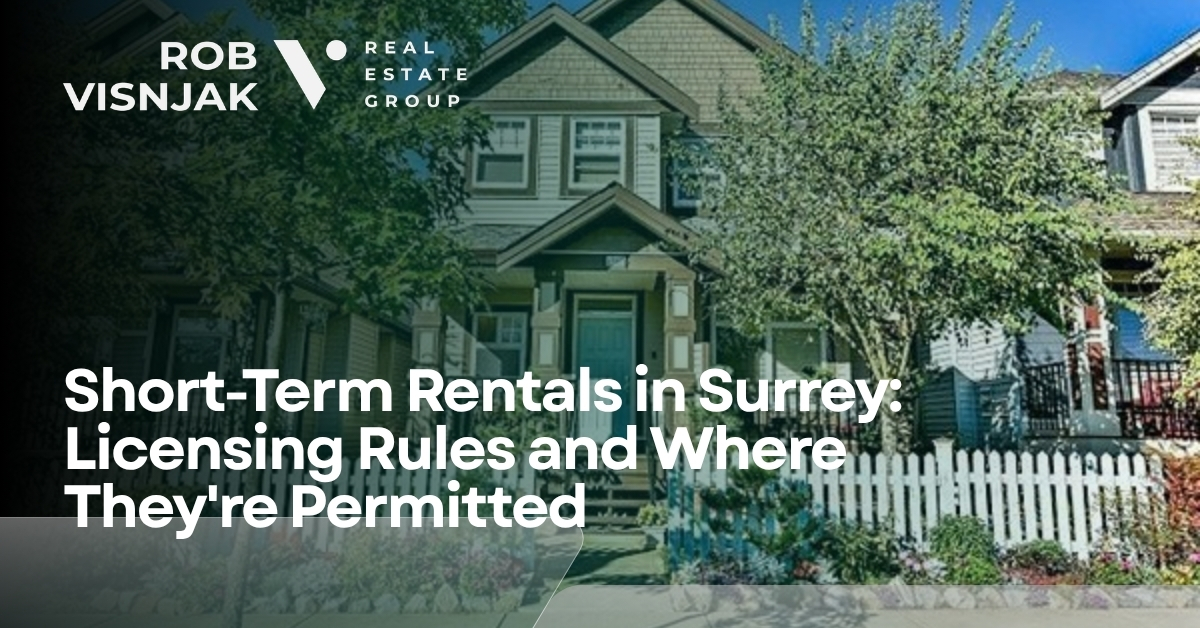
Short-term rentals are legal in Surrey only in the owner's principal residence, plus one declared secondary suite, coach house, garden suite, or lock-off suite on the same lot. Tenants cannot host. A $358 city business licence and a provincial registry number are both required before a listing can stay live.
That owner-only filter is tighter than the provincial floor. According to the Province of British Columbia, the principal residence requirement limits most urban listings to "the host's principal residence, the usual place where they make their home, plus one secondary suite or accessory dwelling unit on the same property." Surrey sits on that covered-community list. The city then adds its own licence, zone list, and a rule that only the registered owner may operate the use.
Price nightly income into a Surrey home search only after the provincial registry, the city licence, the zone, any suite declaration, and any strata bylaw all line up. A listing that is already live is not proof the use is legal.
What counts as a short-term rental in Surrey
The City of Surrey defines a short-term rental as the renting of a dwelling unit by its owner to the public for temporary accommodation for fewer than 90 consecutive days for each guest. Vacation stays, temporary work assignments, and medical stays all count.
Airbnb, VRBO, Booking.com, Facebook Marketplace, Kijiji, and a newspaper classified all sit inside that definition. Hotels, motels, hostels, resorts, bed and breakfast, boarding and lodging, and tourist accommodation sit outside it. A 6-month furnished lease is a tenancy, not a short-term rental.
There is no cap on how many bookings one guest can make across a year. What Surrey will not allow is stacking occupancy. Section 60.1 of Business Licence By-law, 1999, No. 13680 says the host may not offer or accept more than one booking, or otherwise allow more than one person or group to occupy the short-term rental, at one time.
The provincial rule Surrey still has to follow
The Short-Term Rental Accommodations Act sets the floor. As of June 1, 2026, Surrey remains on the Province's list of communities where the principal residence requirement applies. Statistics Canada estimated Surrey's population at 703,531 on July 1, 2025, far above the 10,000-person trigger that puts a city on that list.
Where the requirement applies, a host may offer short-term stays in one or both of these places:
• The dwelling they live in as their day-to-day home.
• Not more than one secondary suite or other accessory dwelling unit on the same parcel.
That second unit can be a basement suite, coach house, garden suite, or lock-off suite. It cannot be a second condo in another building. A host can have only one principal residence at a time.
Surrey's zoning bylaw puts a number on "principal residence." Corporate Report R094, adopted with the 2024 amendments, defines it as a dwelling unit occupied by the owner as the owner's residence for a minimum of 184 days in a calendar year. A weekend house in South Surrey that you visit in summer does not clear that bar.
Hosts, platforms, and strata-hotel platforms must register with the provincial short-term rental registry. That requirement has been in force since May 1, 2025. Registration is per unit, not per property. Display the provincial registration number and the Surrey business licence number on every listing. Details live on the Province's host registration page.
Surrey's owner-only hosting rule
Only the property owner may host a short-term rental in Surrey. The owner must live at the property as their principal residence, either in the same dwelling as the guests or in another dwelling unit on the same lot. The city states that short-term rentals cannot be operated by tenants.
That is the local rule that catches people who assume the provincial Act is the whole story. A renter who lives in a Guildford apartment 365 days a year still cannot list a spare room. The city restricted hosting to owners when Council adopted the June 10, 2024 bylaw amendments.
Mayor Brenda Locke put the policy goal in plain language after those amendments passed: "By taking these steps, we are proactively creating a more balanced housing market that encourages long-term tenancy and provides greater access to stable housing options."
Where short-term rentals are permitted
A city licence does not legalize the use if the dwelling type or the zone is wrong. Confirm both before you apply.
Permitted housing types
The City of Surrey permits a short-term rental only in these housing types, and only if the lot is also the owner's principal residence:
• A single-family dwelling, plus a maximum of one secondary suite, coach house, or garden suite.
• A townhouse unit.
• An apartment unit, plus a maximum of one lock-off suite if the building has one.
Every suite you count toward the listing must already be declared with the city. An undeclared basement in Newton does not become a legal short-term rental because you filed a licence application. Check the suite status first at surrey.ca/suites.
Small-scale multi-unit housing rules can put more dwellings on one lot. They do not expand the short-term rental cap. You still get the principal home plus one accessory unit, not a fourplex of nightly listings.
Permitted zones
Short-term rental is an accessory use in residential, mixed-use, and agricultural zones. The city's published list includes:
• Agricultural and acreage: A-1, A-2, RA.
• Ground-oriented residential: R1, R2, R2-O, R3, R4, R5, R5-S, R6.
• Multiple residential: RM-10, RM-15, RM-23, RM-30, RM-45, RM-70, RM-135, RMC-135, RMC-150.
• Mixed-use commercial: C-15, C-35.
• Applicable Comprehensive Development (CD) zones that already permit a dwelling unit.
Call Planning at 604-591-4448 with the address before you treat that list as a green light. CD zones vary lot by lot. A City Centre tower and a Cloverdale acreage can both be eligible in principle and still fail on strata rules, parking, or an undeclared suite.
The Surrey business licence
Every short-term rental in Surrey needs its own city business licence before the first guest arrives. The current annual fee is $358 plus any applicable application fees, set in Schedule A of Business Licence By-law, 1999, No. 13680.
That fee is the short-term rental category, not a generic home-based business licence. Council set it higher than a bed and breakfast licence because a short-term rental host is often not on site for every stay, which increases the enforcement load.
Once licensed, section 60.1 requires the proprietor to do four things on an ongoing basis:
• Prove, on request, that the unit is the owner's principal residence or a qualifying secondary suite, coach house, garden suite, or lock-off suite on the same lot. Utility bills, government photo ID, vehicle registration, and insurance all count.
• Take only one booking, and one occupant group, at a time.
• Keep each guest's name, address, phone number, email, and arrival and departure dates for two years from the arrival date.
• Register with the provincial short-term rental registry and give the Inspector proof of that registration as soon as it is available.
In March 2026, Council endorsed a streamlined, risk-based licence approval process. That change speeds eligible files. It does not waive zoning, the owner-occupancy test, or the suite-declaration requirement.
What the two layers cost
Budget both governments. The city licence does not replace the provincial registry, and the registry does not replace the city licence.
|
Requirement |
Annual cost |
Who issues it |
|
Surrey STR business licence |
$358 plus application fees |
City of Surrey |
|
Provincial registry, unit you live in |
$100 + $1.50 service fee |
Province of B.C. |
|
Provincial registry, suite you do not occupy |
$450 + $1.50 service fee |
Province of B.C. |
|
GST on bookings |
5% |
Canada Revenue Agency |
|
PST on short-term accommodation |
8% |
Province of B.C. |
|
Surrey MRDT |
3% |
Province, remitted to Surrey |
Registration fees come from B.C. Reg. 268/2023. The $100 rate covers a room in the home you live in, or the whole home while you travel. The $450 rate covers a secondary suite, coach house, garden suite, or other accessory unit that you do not occupy.
Surrey's Municipal and Regional District Tax is 3% on short-term accommodation. Discover Surrey's current MRDT plan runs from June 1, 2025 to May 31, 2030. Registered platforms such as Airbnb and VRBO generally collect GST, PST, and MRDT for you. Stays of 27 consecutive nights or more fall outside PST and MRDT, but the income is still taxable.
Short-term rental versus bed and breakfast
Do not treat a bed and breakfast licence as a workaround. Surrey keeps the two uses separate.
|
Rule |
Short-term rental |
Bed and breakfast |
|
Who can host |
Property owner only |
Owner, as a home occupation |
|
Host on site |
Not required for every stay |
Operated from the home the family occupies |
|
Stay length |
Under 90 consecutive days per guest |
Not more than 30 days in a 12-month period |
|
Suite on the lot |
One declared suite, coach house, or garden suite is allowed |
Not permitted if the property has a secondary suite |
|
City licence |
$358 per year plus fees |
Separate, lower B&B category |
If the property already has a legal secondary suite, the B&B path is closed. The short-term rental path may still be open if you live on the lot and you licence the correct use.
Strata buildings, City Centre condos, and South Surrey townhouses
A city licence and a provincial registration number do not override a strata bylaw. Many Surrey strata corporations already prohibit stays under 30 days, or under 90 days. Read the bylaws and the Form B Information Certificate before you underwrite nightly income on a Whalley tower, a Fleetwood townhouse, or a South Surrey apartment.
Lock-off suites in apartment buildings can qualify only if the building actually has one and the strata documents allow the use. A standard one-bedroom with a den is not a lock-off suite.
If you are buying in Surrey and the seller's pitch includes Airbnb income, treat that pitch as a due-diligence item, not as part of the mortgage file. Lenders qualify you on ordinary income and the stress test, not on an unlicensed listing history.
What happens if you skip the licence
The city and the Province both enforce. Surrey may issue Bylaw Notice Enforcement Notices, Municipal Ticket Informations, start legal proceedings, or take other measures. Complaints go to Business Licensing at 604-591-4370, extension 1, or through the city's online problem form.
The Province's Short-Term Rental Compliance and Enforcement Unit can investigate unregistered listings and principal-residence breaches. Platforms must remove a listing that lacks a valid registration number, and they must remove a listing when the local government asks because the business licence is missing. Existing bookings on an unregistered listing get cancelled.
Under B.C. Reg. 268/2023, a contravention of the principal residence requirement can draw an administrative penalty that scales with repeat offences, up to $10,000. That provincial penalty sits beside, not instead of, a city ticket.
What this means if you are buying or selling
A vacant house in Newton bought "for Airbnb" is not a legal short-term rental. A second property in Cloverdale while you live in Langley is not a principal residence in Surrey. A basement that was never declared will not support a licence.
Build the offer around the home as a place to live, with any legal long-term suite income as a secondary number. First-time buyers who need the numbers to work should price a long-term tenant, not a peak-season calendar. If you want a second set of eyes on a listing that advertises nightly income, book a consult before you write the subject-to clauses.
Rules on the other side of 196 Street are not identical. Langley is two municipalities with their own licence paths. Compare the Surrey owner-only rule with the Langley market page before you assume one Fraser Valley listing strategy travels across the municipal line.
FAQ
Are short-term rentals legal in Surrey?
Yes, but only in the owner's principal residence plus one declared secondary suite, coach house, garden suite, or lock-off suite on the same lot. Tenants cannot host. A Surrey short-term rental business licence and a provincial registry number are both required.
How much is a Surrey short-term rental business licence?
The City of Surrey charges $358 per year plus any applicable application fees. That city licence sits on top of the provincial registry fee of $100 plus $1.50 if you live in the unit, or $450 plus $1.50 if guests stay in a suite you do not occupy.
Can a tenant run an Airbnb in Surrey?
No. Hosting is restricted to the property owner. The owner must live on the lot as their principal residence. A tenant who lists a room or a whole unit is offside the municipal bylaw even if they sleep there every night.
Which Surrey zones allow short-term rentals?
Residential, mixed-use, and agricultural zones on the city's published list, including A-1, A-2, RA, R1 through R6, the RM and RMC multiple-residential zones, C-15, C-35, and applicable CD zones. Confirm your exact zone with Planning at 604-591-4448 before you apply.
Can I buy a vacant Surrey house just to run as an Airbnb?
No. Surrey sits on the Province's principal residence list. A vacant house, a second property across town, or a corporate-owned investment condo is not a principal residence. Nightly income on that purchase is not legal under the Short-Term Rental Accommodations Act.
What if my Surrey strata bans short-term rentals?
The strata rule wins on that lot. A city business licence and a provincial registration number do not override a strata bylaw that prohibits short stays. Read the bylaws and Form B before you treat nightly income as part of the purchase math.

Rob Visnjak Personal Real Estate Corp
Team Lead | ROB VISNJAK REAL ESTATE GROUP
or another way