
Published September 11, 2026
Can You Run an Airbnb in Langley? Business Licence and Bylaw Requirements

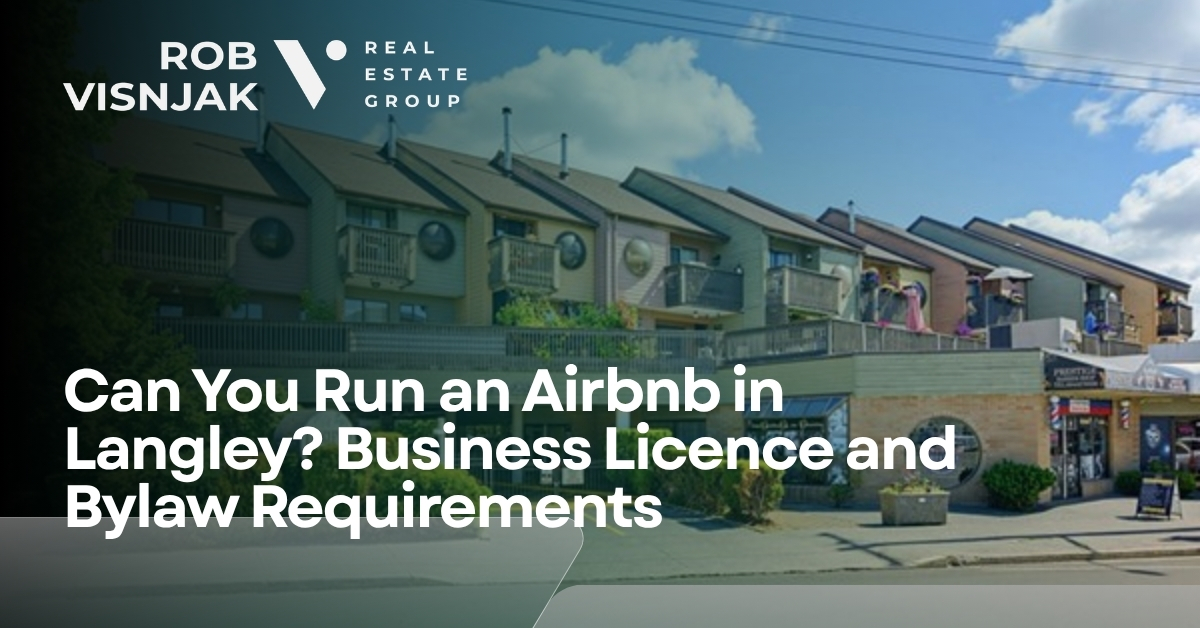
Yes, you can run an Airbnb in Langley, but only in the home you actually live in, plus one legal secondary suite or accessory dwelling on the same lot. A vacant house, a second property, or an investment condo across town does not qualify.
Langley is two municipalities. Walnut Grove, Willoughby, Brookswood, Fort Langley, and Aldergrove sit in the Township of Langley. The compact grid around Douglas Park, Nicomekl, and downtown sits in the City of Langley. Neither hall issues a Vancouver-style short-term rental licence. Both still control the use through zoning, a general business licence, and the provincial Short-Term Rental Accommodations Act.
According to the Province of British Columbia, short-term rentals in covered cities are limited to "the host's principal residence, the usual place where they make their home, plus one secondary suite or accessory dwelling unit on the same property." As of June 1, 2026 that rule applies in both the City of Langley and the Township of Langley.
Price nightly income into a Langley offer only after the provincial registry, the municipal licence, the zone, and any strata bylaw all line up. A listing that is already live is not proof the use is legal.
What counts as a short-term rental in B.C.
A short-term rental is accommodation offered to the public for money for fewer than 90 consecutive days. Airbnb, VRBO, Booking.com, Facebook Marketplace, Kijiji, and a classified ad all count.
Hotels, motels, hostels, resorts, RVs, tents, and bookings of 90 days or longer sit outside the Act. A 6-month furnished lease is a tenancy, not an Airbnb. A weekend listing is a short-term rental even if you never use the word Airbnb.
Hosts, platforms, and strata-hotel platforms must register with the provincial short-term rental registry. That requirement has been in force since May 1, 2025. One registration covers one unit, even if you list the same suite on two platforms.
The provincial rule that decides most Langley listings
The principal residence requirement is the first filter. It is not a Langley invention. It is section 14 of the Short-Term Rental Accommodations Act, and it applies in both Langleys because both sit on the Province's covered-community list.
Where the rule applies, you may offer short-term stays in one or both of these places:
• The dwelling you live in as your day-to-day home.
• Not more than one secondary suite or other accessory dwelling unit on the same parcel.
You can rent a bedroom while you live in the house. You can rent the whole house while you travel. You cannot list the basement suite and the coach house at the same time. You cannot list a second house in Willoughby while you live in a City of Langley condo.
A host can have only one principal residence at a time. Proof is a B.C. ID plus two supporting documents from the prescribed list, such as a property tax notice, Home Owner Grant confirmation, ICBC insurance, or a utility statement.
What the registry costs
Registration is per unit, not per property. Fees under B.C. Reg. 268/2023 are:
• $100 plus a $1.50 service fee if guests stay in the unit you live in, including a room or the whole home while you are away.
• $450 plus a $1.50 service fee if guests stay in a unit you do not live in, including a legal basement suite or coach house on the same lot.
Listings must display the provincial registration number. Where the local government requires a business licence, the listing must also display that licence number. Platforms must take a non-compliant listing down when the local government asks.
City of Langley versus Township of Langley
Call the wrong hall and you will pull the wrong licence form. The postal city on a listing is not the legal municipality.
|
Item |
City of Langley |
Township of Langley |
|
Principal residence rule (June 1, 2026) |
Applies |
Applies |
|
Dedicated Airbnb / STR licence |
None. Use the general business licence. |
None. Use Licencing Bylaw 5878. |
|
Typical home-based licence fee (2026) |
$234 yearly + $60 admin = $294 |
Accessory home occupation $50, plus application fee in Schedule 19 |
|
Zoning hook for a hosted stay |
Bed and breakfast as a home occupation on R1 lots |
Accessory home occupation, or a farm B&B on qualifying rural lots |
|
Whole-home tourist use on a regular house lot |
Tourist accommodation is a hotel or motel use, not an R1 use |
Hotel and motel are commercial uses, not suburban residential uses |
|
B&B in townhouses or apartments |
Home occupation in R2, R3, R4, and R5 excludes bed and breakfast |
Home occupation is not allowed inside a secondary suite |
|
Where to apply |
inspections@langleycity.ca, 604-514-2804 |
buslic@tol.ca, 604-533-6018 |
Rob V., who works with first-time buyers across Langley and Surrey, puts the split this way: "Buyers treat Langley as one market. Licensing does not. A Walnut Grove address and a downtown City of Langley address are two different approval paths, even when both sit on Airbnb."
City of Langley: business licence and zoning
Every business operating in the City of Langley needs a valid licence under Business License and Regulation Bylaw 2013, No. 2916. That includes home-based businesses.
A 2026 home-based business licence is $234 plus a $60 administration fee, for a total of $294. Licences renew each year. Planning staff will not issue a licence for a use the zoning bylaw does not permit at that address.
Bed and breakfast is the City's hosted-stay category
City Zoning Bylaw 2025, No. 3300, adopted March 9, 2026, defines a bed and breakfast as overnight accommodation plus a morning meal, offered as a home occupation, for not more than 30 continuous days per guest.
A home occupation must be run by a resident of that dwelling, may employ no more than one non-resident person, and cannot announce itself with anything larger than a 0.2 m2 nameplate. It cannot create a public nuisance by noise, traffic, or smell.
Bed and breakfast is an accessory home occupation on R1 Suburban Residential lots. It is carved out of home occupation in R2, R3, R4, and R5. A downtown condo or a townhouse is the wrong zone for a B&B even if you live there.
Parking for a bed and breakfast is 1.0 space per sleeping room, on top of the residential parking the house already needs. That ratio is in the City parking table. A two-bedroom listing on a tight R1 lot can fail on parking before it fails on the registry.
What the City does not treat as an Airbnb use
Tourist accommodation in Bylaw 3300 means a hotel, motel, or similar permanent structure used by the traveling public for not more than 30 continuous days. That is a commercial use. It is not a permitted use on a standard house lot.
Bylaw 2916 also says no licence is required to let not more than two rooms, or to rent a single-family dwelling, a secondary suite, a two-family dwelling unit, or a residential strata lot. That exemption is written for ordinary residential rentals. Confirm with City licensing before you treat a nightly listing as licence-exempt. A hosted B&B is still a home occupation, and home occupations are licenced.
Township of Langley: business licence and zoning
Township Licencing Bylaw No. 5878 requires a licence before you operate a business, with narrow exceptions. Starting in 2026 every Township licence renews on the same annual date. A 5% penalty applies 30 days after the due date. Another 5% applies at 90 days.
An accessory home occupation licence is $50 under Schedule 19 of Fees and Charges Bylaw 2007, No. 4616. There is a separate non-refundable application fee that is credited toward the first-year licence if the application is approved.
Home occupation on an urban or suburban lot
Section 104.3 of Zoning Bylaw 2500 is the rule most Willoughby and Walnut Grove hosts actually face. An accessory home occupation:
• Must be run by an owner who lives in the same dwelling.
• Is not permitted inside a secondary suite.
• Cannot change the residential look or character of the house or the street.
• Must sit inside an enclosed building. On urban and suburban lots of 0.25 acres or less, that means inside the house itself.
• Is capped at 50 m2 of floor area on a typical urban or suburban lot, and at 25 m2 in several compact and comprehensive development zones.
Customer visits are tightly limited. Waiting rooms are not permitted. Off-street parking is required where clients attend. A revolving weekend guest list is not the same thing as one client arriving for a haircut. Ask licensing in writing whether your exact listing (room only, whole home while you travel, or locked-off suite) is being accepted as a home occupation.
Farm bed and breakfasts are a different file
On qualifying rural land, the Township allows a bed and breakfast with a maximum of three sleeping units in the principal or an accessory building. The use must be accessory, limited to one establishment per parcel, owner-occupied, and on a lot of at least 1.7 hectares (4.2 acres).
Agricultural Land Commission permission is required where the lot is in the ALR. Health, fire, and building codes apply. A valid business licence is mandatory. Class 9 farm land is also exempt from the provincial principal residence requirement, but ALR designation alone is not an exemption. The assessment class has to be farm.
A 4,000 sq. ft. house on a 6,000 sq. ft. Willoughby lot is not this category. Do not copy a Fort Langley farm B&B file onto an urban lot.
The licence and registry stack, in order
Do the steps in this order. Skipping the zone check is how buyers end up with a live listing and an unusable purchase.
1. Confirm the municipality on the tax notice, not the listing city.
2. Confirm you will live in the unit as your principal residence, or that the second unit is the one allowed suite or ADU on the same parcel.
3. Confirm the suite or coach house is legal. See legal secondary suites in Langley before you list a basement as a guest suite.
4. Read the strata bylaws and the Form B if the property is stratified. A 30-day minimum stay bylaw kills most Airbnb models.
5. Ask City or Township licensing, in writing, which licence type covers your exact use.
6. Apply for the municipal business licence if staff say one is required. Budget a fire inspection in the Township. City staff can hold a licence until a building permit or inspection is cleared.
7. Register the unit with the provincial short-term rental registry and put both numbers on the listing.
8. Register to collect 8% PST on short-term accommodation. Check the provincial MRDT map for any extra local hotel tax. GST applies once you cross the $30,000 small-supplier line.
Strata, landlords, and neighbours
Provincial registration does not punch through a strata bylaw. Many Langley townhouse and apartment strata corporations ban stays under 30 days, or require council approval you will not get. Pull the bylaws before you write nightly income into a Langley home search or an offer subject to financing.
A tenant-host needs written landlord consent. The unit still has to be the tenant's principal residence. Listing a rental suite you do not live in fails the provincial test even if the landlord says yes.
Noise, parking, and waste sit under the ordinary municipal bylaws. Quiet hours, overflowing bins, and cars parked across a neighbour's apron generate complaints. Three complaint files can cost you the municipal licence even when the provincial registration is current.
What it costs when you get it wrong
The Province can issue an administrative penalty for operating offside. Under the Short-Term Rental Accommodations Regulation, failing to register a short-term rental offer carries a maximum of $5,000 on a first contravention, $7,500 on a second, and $10,000 on a third. Contravening the principal residence requirement uses the same $5,000 / $7,500 / $10,000 scale.
Local governments may ticket bylaw offences at up to $3,000 per infraction, per day. Platforms must remove listings that lack a required business licence number. Existing bookings on a removed listing get cancelled.
The Canada Revenue Agency also denies income-tax deductions for a short-term rental that is not permitted, or that is missing a required licence or registration. Mortgage interest, utilities, and maintenance on a non-compliant listing do not come off your return.
What this means if you are buying in Langley
Do not underwrite a Willoughby or Murrayville purchase on year-round Airbnb income. The legal model in both Langleys is a hosted stay in the home you occupy, or one legal suite on that same lot while you live in the other unit.
If the business case is long-term rent from a legal suite or a coach house, run the numbers as a tenancy, not as a hotel. That is the use first-time buyers in Langley can actually take to a lender. Nightly income is extra, and only after the licence stack is done.
Mortgage qualifying still uses the stress test and your documented income, not last summer's Airbnb calendar. If you want a second set of eyes on an address before you write an offer, book a consult or start the home-buying process.
FAQ
Do I need a separate Airbnb licence in the City of Langley or the Township?
No. Neither hall issues a dedicated Airbnb licence. You register with the Province ($100 if you live in the unit, $450 if the unit is a suite or accessory dwelling) and you apply for a municipal business licence if the use is a home occupation or other licenced business. City of Langley 2026 home-based licences are $234 plus $60 administration. Township accessory home occupation licences are $50 plus the Schedule 19 application fee.
Can I Airbnb a basement suite in Langley while I live upstairs?
Provincially, yes, if the house is your principal residence and the suite is the one allowed accessory unit on that parcel. The suite must be legal. City Zoning Bylaw 3300 still requires the registered owner to live in either the principal dwelling or the suite. An illegal locked-off basement does not qualify.
Can a tenant in Langley host an Airbnb?
Only with written landlord consent, a legal unit, and a listing that still meets the provincial principal residence test. The host must live in that unit as their day-to-day home. A tenant who lists a vacant investment suite they do not occupy is offside in both municipalities.
What if my Langley strata bans short-term rentals?
The strata rule wins on that lot. Provincial registration and a municipal licence do not override a bylaw that prohibits short stays. Read the bylaws and Form B before you count nightly income on a Walnut Grove townhouse or a City of Langley condo.
Which hall do I call, City of Langley or Township of Langley?
Walnut Grove, Willoughby, Brookswood, Fort Langley, and Aldergrove are Township. The grid around Douglas Park, Nicomekl, and downtown is City of Langley. Zoning and licences follow the municipality on the tax notice.
Can I buy a vacant Langley house just to run as an Airbnb?
No. As of June 1, 2026 the principal residence requirement applies in both Langleys. A vacant house, a second property, or a corporate-owned condo is not a principal residence. Nightly income on that purchase is not legal under the Act.

Rob Visnjak Personal Real Estate Corp
Team Lead | ROB VISNJAK REAL ESTATE GROUP
or another way