
Published August 20, 2026
The Foreign Buyer Ban in BC: What It Blocks and When It Sunsets
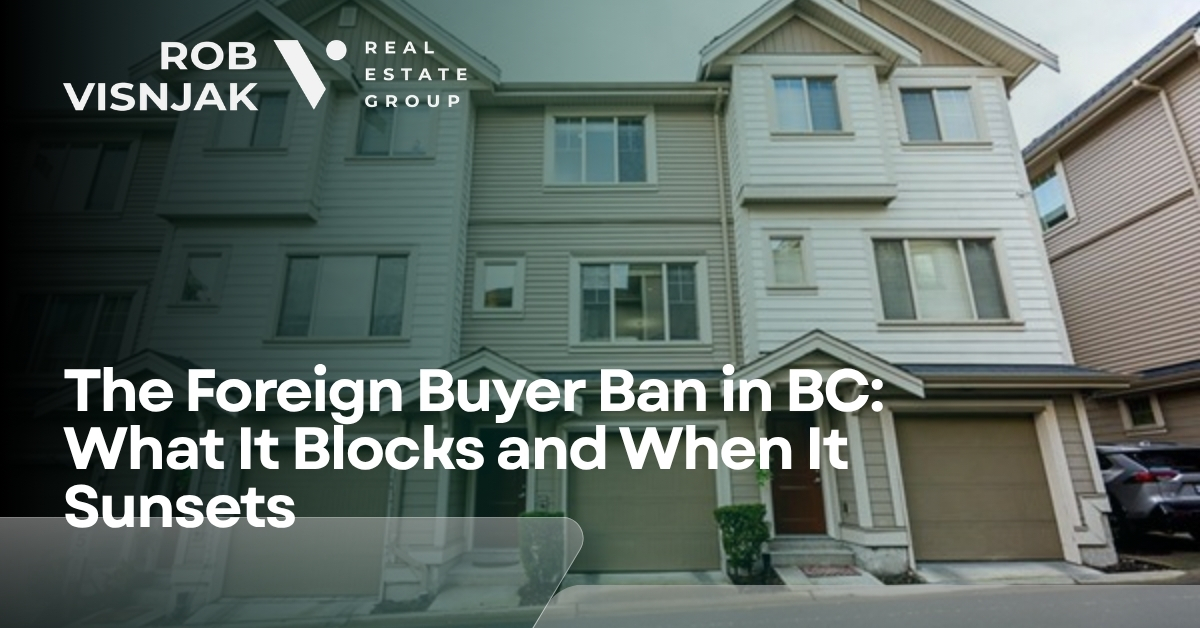
Canada’s foreign buyer ban remains in effect through December 31, 2026, with the current legislation scheduled to sunset on January 1, 2027. It generally prevents non-Canadians from purchasing covered residential property in urban areas, but exemptions can apply to permanent residents, work-permit holders, protected persons, qualifying students, and buyers purchasing with an eligible Canadian spouse or common-law partner. The federal government extended the ban to January 1, 2027.
The rules matter directly to buyers considering Surrey, Langley, and other Fraser Valley communities. The ban is separate from BC’s additional property transfer tax, so an exemption from one program does not automatically create an exemption from the other.
What the Foreign Buyer Ban Blocks
The Prohibition on the Purchase of Residential Property by Non-Canadians Act generally blocks a non-Canadian from buying covered residential property located within a census metropolitan area or census agglomeration. Covered property includes detached homes, semi-detached homes, townhouses, and condominium units in buildings with three homes or fewer, including individual units in qualifying buildings. Federal housing guidance explains the geographic and property rules.
· Buying a detached house, semi-detached home, or townhouse in a covered urban area when no exemption applies.
· Purchasing a condominium unit in a covered building.
· Buying indirectly through a corporation controlled by a non-Canadian.
· Using a trust or other structure to avoid the prohibition.
· Entering a transaction without confirming the buyer’s immigration status, property location, and exemption documents.
Who Is Considered a Non-Canadian?
The prohibition generally targets individuals who are not Canadian citizens, permanent residents, or persons registered under the Indian Act, as well as certain privately held corporations controlled by non-Canadians. A buyer’s passport alone does not answer every question because immigration status, corporate ownership, trust arrangements, and the identity of co-purchasers can affect the analysis.
Canadian citizens and permanent residents are not prohibited by this federal ban. They still need to budget for normal closing costs, financing requirements, and BC property transfer tax. Buyers should confirm whether another provincial tax applies to their ownership structure.

Main Exemptions to Know
The exemptions are specific and should be confirmed before signing a contract. A buyer who appears to qualify should collect proof early, because immigration documents and tax records may be needed by a lawyer, notary, lender, or real estate professional.
Work-Permit Holders
Certain work-permit holders can purchase one residential property if they meet federal requirements. The commonly cited rule requires at least 183 days of validity remaining on the work permit or work authorization at the relevant time, and the buyer cannot have already purchased a residential property during the prohibition under that exemption. Current regulatory guidance should be checked before relying on this route.
International Students
The student exemption is much narrower. Eligible students generally must satisfy requirements involving attendance at a designated learning institution, Canadian tax filings, physical presence in Canada, and a maximum purchase price of $500,000. Holding a study permit alone is not enough.
Protected Persons and Eligible Spouses
Protected persons and certain refugees may be exempt if they have the required status under Canadian immigration law. A non-Canadian may also qualify when purchasing with an eligible Canadian citizen or permanent-resident spouse or common-law partner. The ownership structure and relationship status must be verified before signing.

Properties Outside the Ban
The federal prohibition is not a blanket ban on every type of Canadian real estate. The regulations use geographic and property definitions that may exclude certain properties outside a census metropolitan area or census agglomeration, as well as some larger multi-unit residential buildings and other categories. Verify the applicable Statistics Canada classification and legal description rather than relying on marketing language.
This distinction can matter in rural parts of the Fraser Valley, but a property marketed as rural may still fall within a covered census area. Zoning and the number of residential units can also change the analysis.
Surrey and Langley: Why Location Matters
Surrey is part of a major metropolitan urban area, so typical houses, townhomes, and condos are generally within the federal framework. Langley properties require a closer look because the relevant municipal location and census classification can affect whether the ban applies. Verify the exact address before making an offer.
A buyer may be legally permitted to purchase but still need mortgage pre-approval, compliant down payment funds, insurance, and a plan for BC taxes and closing costs. The home buying process should be treated as both a legal and financial review.
Federal Ban vs. BC Foreign Buyer Tax
The federal ban determines whether a non-Canadian may purchase covered residential property at all. BC’s Additional Property Transfer Tax is different: it can impose a 20% tax on the foreign buyer’s proportionate share of the fair market value of residential property in specified areas, including the Fraser Valley Regional District. The BC government confirms the 20% rate and specified regions.
|
Rule |
Federal foreign buyer ban |
BC Additional Property Transfer Tax |
|
Purpose |
Restricts certain purchases |
Adds tax to certain taxable transfers |
|
Applies to |
Covered non-Canadian buyers and entities |
Foreign nationals, foreign corporations, and taxable trustees |
|
Surrey/Langley relevance |
Property classification and urban geography matter |
Fraser Valley Regional District is a specified area |
|
Rate |
Not a tax |
20% on the applicable residential share |
|
Can one exemption solve both? |
No |
No; each program has separate rules |

What Buyers Should Do Before Making an Offer
Do not wait until completion to investigate foreign-buyer rules. Confirm eligibility before signing a Contract of Purchase and Sale because a transaction that violates the federal prohibition can create serious legal and financial consequences.
1. Confirm your status: citizenship, permanent residence, work permit, study permit, protected-person status, or another immigration category.
2. Identify the property type and exact location, including its census classification.
3. Ask a Canadian real estate lawyer or notary to review the exemption before submitting an offer.
4. Speak with a mortgage professional about lender requirements, source-of-funds documentation, and insurance.
5. Calculate BC taxes separately, including the Additional Property Transfer Tax where applicable.
When Does the Ban Sunset?
The current federal legislation is scheduled to sunset on January 1, 2027, meaning the prohibition is intended to remain in force through December 31, 2026. A sunset date does not guarantee that every restriction disappears permanently; Parliament could extend, replace, amend, or repeal the rules. Confirm the law in force when you sign and when the transaction closes.
The BC Additional Property Transfer Tax does not automatically disappear when the federal ban sunsets. It is a separate provincial program with its own rules and exemptions. January 1, 2027 should not be treated as the end of all foreign-buyer costs.
Conclusion
The BC foreign buyer ban blocks most non-Canadians from purchasing covered residential property in urban areas through the end of 2026, but it does not apply equally to every buyer or every property. Work-permit holders, qualifying students, protected persons, and non-Canadians buying with an eligible spouse may have exemptions, while BC’s separate 20% additional property transfer tax can still apply.
If you are planning to buy a home in Surrey, Langley, or another Fraser Valley community, start by confirming your eligibility and the property’s classification. The Rob Visnjak Real Estate Group can help coordinate the real estate side, while a qualified lawyer, notary, tax adviser, and mortgage professional should confirm your legal and financial position. Book a consultation or explore financing resources before making an offer.
FAQ: Foreign Buyer Ban in BC
When does the foreign buyer ban in Canada end?
The current legislation is scheduled to sunset on January 1, 2027, so it is intended to remain in effect through December 31, 2026. The government could amend or replace it before then.
Can a work-permit holder buy a home in BC?
Some work-permit holders can qualify to purchase one residential property if they meet the applicable federal conditions, including the required validity remaining on their work authorization.
Can international students buy property in Surrey or Langley?
Only some international students qualify under a narrow exemption. Requirements can include Canadian tax filings, physical presence, enrollment at a designated institution, and a maximum purchase price of $500,000.
Does the foreign buyer ban apply to Langley?
It may apply depending on the property type and census classification. Verify the exact address and legal description before relying on an exemption or geographic exception.
Is BC’s 20% foreign buyer tax the same as the federal ban?
No. The federal ban restricts certain purchases, while BC’s Additional Property Transfer Tax is a separate provincial tax that can charge 20% on the applicable residential share in specified regions, including the Fraser Valley.
Can a non-Canadian buy with a Canadian spouse?
A non-Canadian may qualify when purchasing with an eligible Canadian citizen or permanent-resident spouse or common-law partner, but the relationship and ownership requirements must be verified.
What happens if a buyer violates the foreign buyer ban?
A prohibited transaction can create significant legal and financial risk, including penalties and orders requiring the property to be sold. Obtain legal advice before signing.
Rob Visnjak Personal Real Estate Corp
Team Lead | ROB VISNJAK REAL ESTATE GROUP
or another way