
Published May 24, 2026
Buying a Condo in BC: Complete Buyer's Guide

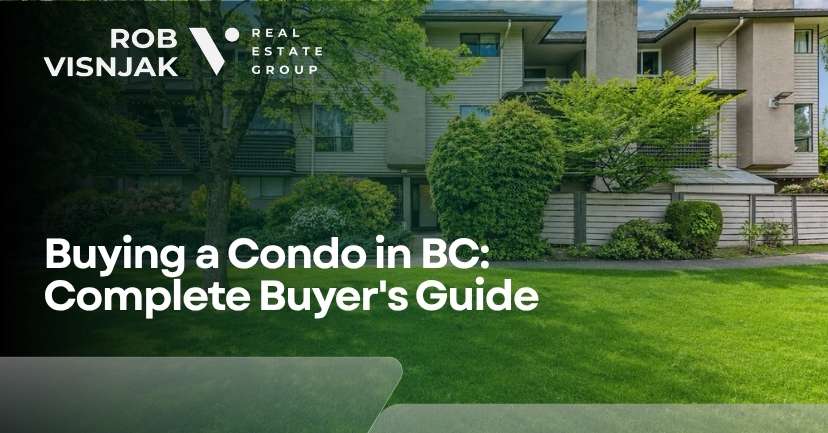
Buying a condo in BC is fundamentally different from buying a detached home. You are not just purchasing a unit — you are buying into a strata corporation, a shared legal entity that governs the building, sets bylaws, collects monthly fees, and makes major spending decisions that directly affect your investment.
Approximately one in four BC residents lives in strata housing, according to the Province of British Columbia. Understanding what you are getting into before signing the Contract of Purchase and Sale is critical. This complete guide walks you through every stage — from financial preparation to reviewing strata documents — so you can buy with confidence. If you are also comparing property types, read the full condo vs townhouse breakdown before deciding.
Step 1: Know What You Can Afford
The first step to buying a condo in BC is establishing your true budget — not just the purchase price, but the full monthly cost of ownership. A condo comes with a mortgage payment plus a mandatory monthly strata fee, which must both fit within your debt service ratios to qualify for financing.

In 2026, the median condo price in Langley sits at approximately $567,000, while Surrey's median condo is around $575,000. These are entry-level price points for the Fraser Valley. Your minimum down payment depends on the purchase price:
· Under $500,000: Minimum 5% down payment required.
· $500,000 to $999,999: 5% on the first $500,000 and 10% on the remaining balance.
· $1,000,000 and above: Minimum 20% down payment required — no CMHC insurance available.
If your down payment is under 20%, CMHC mortgage default insurance is mandatory. The premium ranges from 2.80% to 4.00% of the insured mortgage amount and is added directly to your loan balance. Always get a full mortgage pre-approval — not just a pre-qualification — before beginning your condo search. Read our guide on how much mortgage you can afford to calculate your exact numbers.
Step 2: Budget for Closing Costs
Closing costs are the additional expenses paid on top of your down payment on completion day. BC buyers should budget 1.5% to 4% of the purchase price in closing costs, in addition to their down payment.
Typical BC Condo Closing Costs (2026)
|
Cost Item |
Typical Amount |
Notes |
|
BC Property Transfer Tax (PTT) |
1% on first $200K; 2% on balance up to $2M |
First-time buyers exempt on resale up to $835,000 |
|
Legal / Notary Fees |
$1,500 - $2,500 |
Plus $300-$500 in disbursements |
|
Home Inspection |
$350 - $500 |
Paid during subject removal period |
|
Title Insurance |
$200 - $400 |
One-time, strongly recommended |
|
Strata Move-In Deposit |
$200 - $500 |
Often refundable; set by strata |
|
Property Tax Adjustment |
Prorated at closing |
Depends on completion date |
|
CMHC Insurance Premium |
2.80% - 4.00% of mortgage |
Added to loan if under 20% down |
|
GST (new builds only) |
5% of purchase price |
Partial rebate available under $450K |
First-time buyers qualify for a full PTT exemption on resale condos priced up to $835,000, saving up to $13,000. On a newly built condo priced up to $1,100,000, a separate newly built home exemption also applies. Confirm your eligibility with your lawyer or notary before closing.
Step 3: Understanding Strata Living in BC
When you buy a condo in BC, you automatically become a member of the strata corporation — the legal entity governed by the Strata Property Act. Every condo owner pays monthly strata fees, which fund the day-to-day operating expenses of the building and contribute to the Contingency Reserve Fund (CRF) for future major repairs.

In 2026, average monthly strata fees in the Fraser Valley are:
· Concrete high-rise condos: $0.55 to $0.70 per square foot per month. An 800 sq ft unit typically costs $440 to $560 per month.
· Wood-frame low-rise condos: $0.45 to $0.55 per square foot per month. An 800 sq ft unit typically costs $360 to $440 per month.
Higher strata fees are not automatically a red flag. A building with healthy reserves and proactive maintenance costs more monthly but protects you from sudden, large special assessments. A building with suspiciously low fees often has an underfunded CRF — a major financial risk.
Step 4: The Critical Strata Document Review
Reviewing strata documents is the single most important due diligence step when buying a condo in BC. Your offer must include a subject-to-strata-document-review clause, giving you 5 to 7 business days to review the full document package.
The strata document package must include:
1. Last two years of strata council meeting minutes — these reveal unresolved disputes, pending repairs, problem owners, and upcoming votes that affect your unit.
2. The most recent depreciation report — a mandatory engineering report that assesses the physical condition of all major building components and projects repair costs over a 30-year period.
3. The current operating budget and financial statements — confirm the building is living within its financial means.
4. The Contingency Reserve Fund (CRF) balance — a healthy reserve is essential to fund major future repairs without issuing a special assessment to owners.
5. Form B (Information Certificate) — the strata's official disclosure document confirming current fees, outstanding levies, and any liens against your specific unit.
6. The strata's bylaws and rules — critical for understanding pet restrictions, rental allowances, renovation rules, and short-term rental prohibitions.
The 2026 Depreciation Report Rule Change
Starting in 2026, a critical loophole in BC strata law has been closed. Previously, a strata corporation could pass a vote to waive or defer its depreciation report indefinitely. This allowed poorly managed buildings to hide deteriorating infrastructure from buyers. Under the 2026 regulatory changes, this waiver option has been eliminated for most strata corporations.
This is significant for buyers. You now have the legal right to demand an up-to-date, valid depreciation report as part of your strata document package. If a building's depreciation report is severely outdated or shows a large funding deficit, treat this as a serious red flag and walk away or negotiate a significant price reduction.
Step 5: Watch for Special Assessments
A special assessment (also called a special levy) is a one-time charge issued by the strata corporation to all unit owners when the Contingency Reserve Fund does not have enough money to cover a major repair — such as a roof replacement, elevator overhaul, or building envelope remediation. These assessments can range from a few thousand to tens of thousands of dollars per unit, with no warning.
When reviewing the strata minutes and depreciation report, specifically look for:
· Any votes to defer repairs that the depreciation report flagged as urgent.
· A CRF balance that is significantly below the level recommended in the depreciation report.
· Any currently pending special assessments already approved by the strata council.
· A pattern of rising strata fees year-over-year, which sometimes signals financial mismanagement.
Step 6: Review the Bylaws Before You Buy
Strata bylaws govern what you can and cannot do in your unit and on common property. BC Bill 44, enacted in November 2022, voided all strata bylaws that prohibited rentals or restricted ownership to residents over 55 years of age. This means virtually all BC strata corporations must now allow long-term rentals — a significant positive change for investors.
However, other bylaw restrictions remain fully enforceable. Before purchasing, confirm the following with your agent and strata documents:
· Pet bylaws: Size, breed, and number of pets allowed. Some buildings still prohibit dogs entirely.
· Short-term rental bylaws: Most BC stratas explicitly prohibit Airbnb-style rentals despite the rental bylaw change.
· Renovation rules: Some buildings require strata council approval before any renovation, even cosmetic changes.
· Move-in and move-out restrictions: Many buildings charge move-in deposits and restrict moving to business hours only.
Step 7: Making an Offer on a BC Condo
Once you have found the right unit, your real estate agent will prepare a Contract of Purchase and Sale. For a condo, your offer should include at minimum four subject clauses to protect you:
7. Subject to financing: Gives you 5 to 7 business days to finalize your mortgage approval.
8. Subject to home inspection: Covers the physical condition of your specific unit. Note that a home inspector does NOT review strata documents — this is a separate clause.
9. Subject to strata document review: Gives you the right to review all strata documents before the deal becomes firm.
10. Home Buyer Rescission Period (HBRP): BC law automatically grants buyers a 3-business-day cooling-off period after offer acceptance. The buyer can cancel for any reason but forfeits 0.25% of the purchase price as a rescission fee.
Once all subjects are removed in writing, the deal becomes legally binding. The completion date typically occurs 2 to 6 weeks after subject removal, followed by possession day one to two days later.
New Build vs. Resale Condo in BC
Buying a pre-sale or new construction condo involves a completely different process. You sign a developer's contract, pay a deposit in stages (typically 5% to 20% over 12 to 24 months), and wait 1 to 3 years for completion. New builds are subject to 5% GST, though a partial rebate is available on units under $450,000.
Resale condos offer immediate possession, visible strata history, and no GST on the purchase price. However, they may come with aging infrastructure, underfunded reserves, or restrictive old bylaws. In a buyer's market — which is where the Langley and Surrey condo market sits in 2026 — resale condos can often be purchased significantly below list price with strong negotiating leverage.
FAQ: Buying a Condo in BC
What is a strata corporation in BC?
A strata corporation is the legal entity created when a strata development is registered. It governs the building, manages shared property, sets bylaws, collects strata fees, and makes decisions about major repairs. Every condo owner is automatically a member and has voting rights.
What documents should I review before buying a condo in BC?
You must review the strata's last two years of meeting minutes, the current depreciation report, financial statements, the Contingency Reserve Fund balance, Form B (Information Certificate), and the strata bylaws. Your subject-to-strata-document-review clause gives you the legal right to request and review all of these before the deal becomes firm.
What is a depreciation report and why does it matter?
A depreciation report is an engineering assessment of the building's major components — roof, plumbing, elevators, building envelope — that projects repair timelines and costs over 30 years. As of 2026, BC eliminated the loophole that allowed strata corporations to indefinitely waive this report. A healthy depreciation report with a well-funded reserve is one of the strongest indicators of a sound condo investment.
Can I rent out my BC condo on Airbnb?
Likely no. While BC Bill 44 (2022) voided rental prohibition bylaws for long-term rentals, most strata corporations have enacted specific bylaws prohibiting short-term rentals such as Airbnb. Always confirm the strata's current rules on short-term rentals before purchasing as an investment.
How much are closing costs on a condo in BC?
Budget 1.5% to 4% of the purchase price for closing costs. The largest variable is the BC Property Transfer Tax (PTT), which is 1% on the first $200,000 and 2% on the remainder up to $2 million. First-time buyers receive a full PTT exemption on resale homes priced up to $835,000.
What is the Home Buyer Rescission Period for condos in BC?
BC law gives buyers a 3-business-day rescission period after an offer is accepted on a residential property. The buyer can cancel the contract for any reason during this window by notifying the seller in writing and paying a rescission fee equal to 0.25% of the agreed purchase price.
Is now a good time to buy a condo in BC?
In 2026, the Fraser Valley condo market is firmly in buyer's market territory, with increased inventory and softened prices in both Langley and Surrey. Buyers have significant negotiating leverage, and those purchasing near the planned SkyTrain extension route in Langley City are positioned for strong future appreciation once the line opens in 2028 or 2029.
Conclusion
Buying a condo in BC requires a higher level of due diligence than purchasing a detached home. Beyond the standard financial preparation, you must thoroughly review the strata documents, understand your monthly fee obligations, check the depreciation report, and scrutinize the bylaws before committing to a purchase. The 2026 regulatory changes around depreciation reports make this process more transparent than ever — but only if you know what to look for.
Whether you are a first-time home buyer entering the market or an experienced investor seeking to expand your portfolio, having an experienced real estate agent by your side is the best protection you have. Your agent will arrange the strata document review, interpret red flags, and negotiate on your behalf — at no direct cost to you.
The Rob Visnjak Real Estate Group helps BC buyers navigate the condo market in Langley, Surrey, and across the Fraser Valley. Book a free consultation today, or search active condo listings to start comparing properties right now.

Rob Visnjak Personal Real Estate Corp
Team Lead | ROB VISNJAK REAL ESTATE GROUP
or another way